How to Teach Your Preschooler Letters and Numbers at Home
If you've ever sat down with your 4-year-old and a worksheet — and watched their attention drift in under 90 seconds — you're not alone. Young children aren't wired for traditional classroom learning. But they are wired for play, stories, repetition, and connection.
The good news: there are simple, low-pressure ways to help your preschooler build real literacy and numeracy skills at home — without turning your kitchen into a classroom.
Why Preschoolers Learn Differently
Children ages 3–10 are in a critical period for brain development. They absorb language, pattern recognition, and foundational concepts at an extraordinary rate — but only when they feel safe, engaged, and not under pressure. Forced repetition and drills often backfire, creating anxiety around letters and numbers before a child even starts school.
What works instead: embedding learning into play, daily routines, and moments children already enjoy. Small doses, repeated often, in contexts that feel natural.
9 Practical Tips That Actually Work
1 Start with their name
A child's own name is the most motivating letter sequence in the world. Write it out, point to the letters individually, and celebrate each one. Most children learn to recognize their name before any other word — and that recognition builds confidence for everything that follows.
2 Read together — and point
When reading picture books, run your finger under the words slowly. You don't need to teach every word — just building the understanding that text goes left to right, and that those marks represent sounds, is enormously valuable. Children who are read to daily enter school with a significant vocabulary advantage.
3 Sing the alphabet — then slow it down
The alphabet song is a great start, but it runs letters together (L-M-N-O-P becomes one blur). Once your child knows the song, practice singing it slowly — one letter per breath. Then play "find that letter" in books, on signs, or food packaging.
4 Count everything in daily life
Stairs, grapes, fingers, steps to the car. Counting out loud during normal activities builds number sense far more effectively than worksheets. When children count objects they can touch, they learn that numbers represent real quantities — not just sounds in a sequence.
5 Use apps built for this age
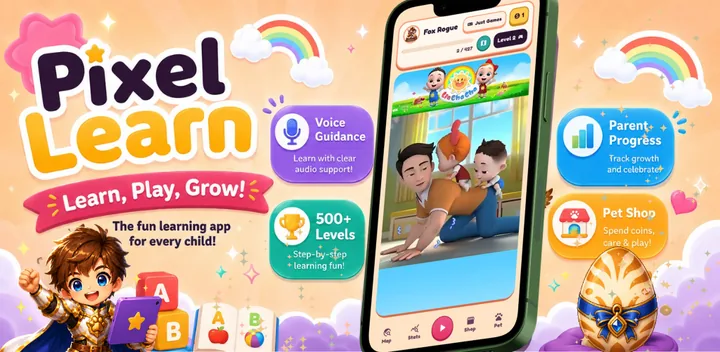
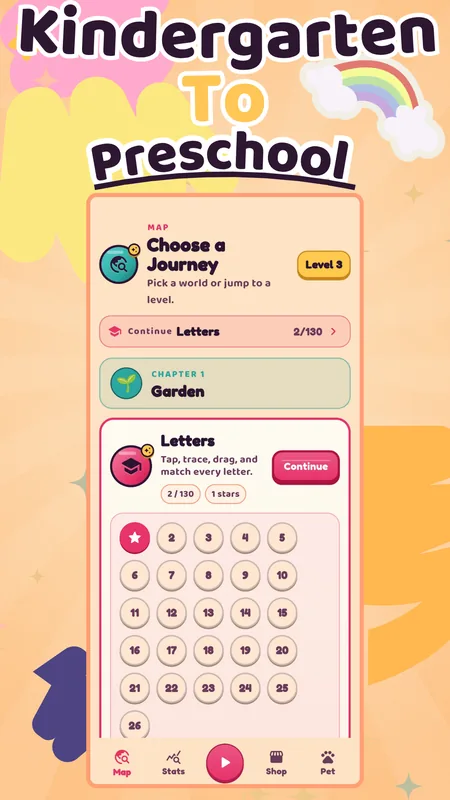
A well-designed learning app can do something you can't always do yourself: provide consistent, patient, voice-guided practice, 5 minutes at a time, every day. The key is choosing one built around actual educational principles — short sessions, real skill content, no passive watching, and a motivation system that keeps children coming back.
Look for apps that practice specific skills (letters, numbers, memory, tracing), use voice guidance so pre-readers can play independently, and give you a parent view of progress.
6 Trace before you write
Fine motor skills need to develop before children can hold a pencil well. Start with large-scale tracing — finger tracing letters in sand, playdough shapes, or finger painting. Then move to guided tracing in apps or on paper. Many apps (including PIXEL-LEARN) include tracing games that help children learn letter formations before they pick up a pencil.
7 Play matching and memory games
Matching games — whether physical card pairs or digital — build working memory, visual discrimination, and the ability to hold information while scanning for a match. These are foundational skills for both reading (recognizing letter patterns) and math (comparing quantities). Even 5 minutes of a matching game, three times a week, adds up quickly.
8 Don't correct — redirect
When a child says "that's a B!" and it's actually a D, resist the urge to immediately correct. Instead, say: "Wow, you're looking carefully! That one curves this way — so it's a D. D says 'duh'." Harsh correction creates fear of being wrong. Gentle redirection keeps the experience positive and the child eager to try again.
9 Keep sessions short
Five minutes of focused, engaged practice is worth more than 30 minutes of half-attention. End sessions before the child is frustrated or bored — always leave them wanting a little more. This is the single most underrated technique in early learning.
When to Start and What to Expect
Most children begin recognizing some letters between ages 3 and 4, and most can identify all 26 letters by age 5 or 6. For numbers, children typically count to 10 reliably around age 4 and recognize written numbers 0–9 around age 5.
But there's enormous variation — and that's normal. Some 3-year-olds can identify 20 letters. Some 5-year-olds are still solidifying their alphabet. The goal of home practice isn't to accelerate beyond peers; it's to build a confident, positive relationship with learning before formal schooling begins.
A Simple Weekly Routine
- Monday, Wednesday, Friday: 5 minutes on a learning app (letters or numbers)
- Tuesday, Thursday: Read together and point to letters or count objects in the illustrations
- Daily: Count one everyday thing — stairs, bites of food, cars you pass
- Weekend: One physical activity — letter tracing in sand, playdough numbers, or a matching card game
That's approximately 25–35 minutes of learning per week — embedded naturally, without pressure, without worksheets.
Signs Your Approach Is Working
- Your child points out letters on signs, packaging, or books without prompting
- They ask you to write words or their name
- They count objects spontaneously during play
- They ask to play their learning app again
- They correct themselves — "wait, that's not a B, that's a D"
- They feel proud and confident about letters and numbers
Frequently Asked Questions
PIXEL-LEARN Makes Daily Practice Easy
5-minute learning games, voice guidance, 500+ levels, and a digital pet that keeps kids coming back. Free on Google Play.
Download PIXEL-LEARN Free